

Introduction
Most businesses in the UAE don’t lose deals because their product is weak. They lose deals because a lead sits in someone’s inbox for three days before anyone replies. CRM sales and marketing automation exists to close that gap. It connects the moment a lead shows interest to the moment your team follows up, sells, and keeps that customer coming back — without depending on someone remembering to do it manually.
At IntelMark, we build and implement CRM automation systems for real estate agencies, property developers, SMEs, and enterprises across Dubai, Abu Dhabi, and Sharjah. This page walks through exactly what CRM automation is, how it works, and what it can realistically do for your sales and marketing teams.
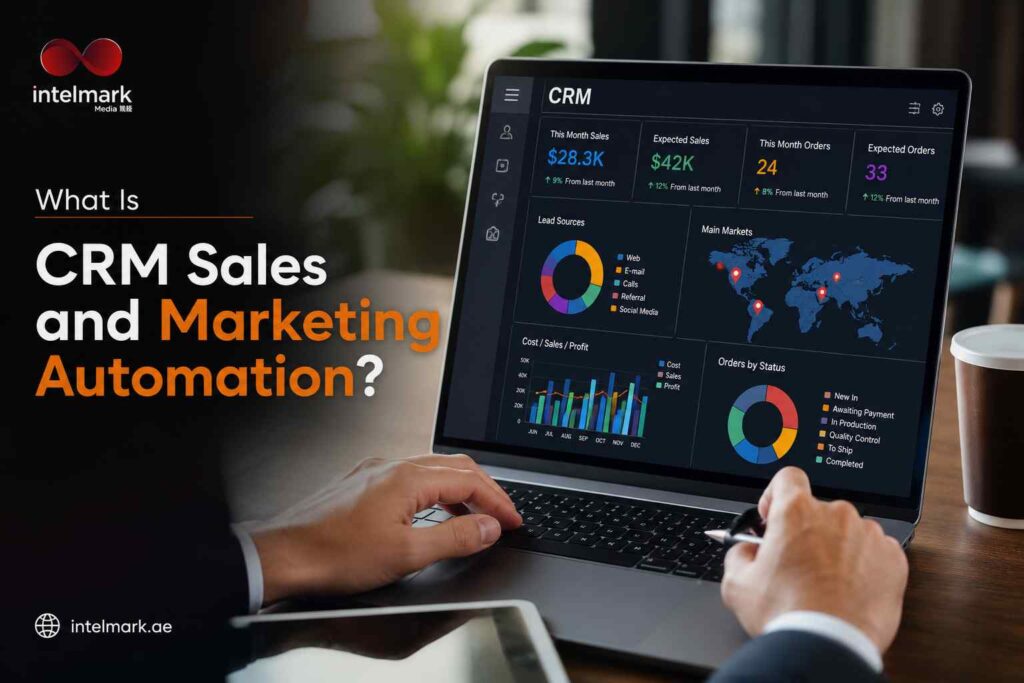
What Is CRM Sales and Marketing Automation?
CRM sales and marketing automation is the practice of using a connected system — your CRM — to run the repetitive parts of selling and marketing automatically. Instead of a salesperson manually logging every call or a marketer manually emailing every subscriber, the CRM does it: scoring leads, sending follow-ups, triggering campaigns, and updating pipelines in real time.
It’s not a single tool. It’s a workflow. A property developer’s website form submission can automatically create a lead, assign it to the right agent, send a WhatsApp confirmation, and schedule a follow-up call — all within seconds, with zero manual data entry.
Why UAE Businesses Are Moving to Automated CRM
The UAE market moves fast, and buyers expect a response within minutes, not days. We’ve worked with real estate agencies where a five-minute delay in responding to an inquiry meant the lead had already messaged three other agents. Automated CRM systems remove that delay entirely.
There’s also the visibility problem. Business owners often don’t know how many leads are actually being followed up on until deals stop closing. A properly automated CRM gives you a live view of every lead, every stage, and every conversation, so decisions are based on data instead of guesswork.
Sales Automation vs Marketing Automation
These two get used interchangeably, but they solve different problems.
Sales automation handles what happens after someone becomes a lead — pipeline stages, task reminders, quote generation, follow-up sequences, and deal tracking. It’s built for your sales team’s daily workflow.
Marketing automation handles what happens before and around that — email sequences, ad retargeting, lead nurturing, and campaign scheduling. It’s built to bring leads in and keep them warm until sales is ready to talk to them.
The businesses that grow fastest use both together, feeding the same CRM, so marketing and sales are never working from two different pictures of the same customer.

Core Features That Actually Drive Results
Lead Scoring & Pipeline Management Not every lead deserves the same attention. Lead scoring ranks prospects by intent — page visits, form fills, WhatsApp replies — so your team spends time on the leads most likely to close, while pipeline management keeps every deal’s stage visible on one board.
Email, WhatsApp & SMS Automation In the UAE, WhatsApp often outperforms email for response rates. A good CRM automation setup triggers the right channel at the right moment — a WhatsApp confirmation immediately after inquiry, an email nurture sequence over the following week, and an SMS reminder before a scheduled viewing or meeting.
Follow-Up & Task Automation Leads rarely convert on the first contact. Automated follow-up sequences make sure no one falls through the cracks, while task automation assigns reminders to the right team member automatically, instead of relying on memory or spreadsheets.
Workflow Automation & AI Integration Beyond individual actions, workflow automation chains multiple steps together — a new lead can trigger scoring, assignment, a welcome message, and a CRM note in one motion. AI integration adds a layer on top, flagging which leads are likely to convert and even drafting first-response messages your team can approve and send.
Reporting & Analytics None of this matters if you can’t see the results. Real-time dashboards show conversion rates, response times, and campaign performance, so you know exactly what’s working and what needs adjusting.
CRM Automation by Business Type
Real Estate Agencies & Developers get the most dramatic results, since speed-to-lead directly affects sales. Automated systems route inquiries to available agents instantly and track every viewing, offer, and follow-up in one place.
SMEs typically need a leaner setup — automated lead capture, follow-up sequences, and simple reporting, without the complexity or cost of an enterprise system.
Enterprises usually need deeper integration — CRM connected to existing sales tools, multiple departments, and detailed reporting across regions or business units.
How IntelMark Implements CRM Automation
We start by mapping your current sales and marketing process — where leads come from, where they get stuck, and where manual work is slowing things down. From there, we set up the CRM, build automation workflows for lead scoring, follow-ups, and campaigns, connect WhatsApp/email/SMS channels, and train your team to use the system properly. We stay involved after launch to refine workflows based on real performance data, not assumptions.

Mistakes Businesses Make With CRM Automation
The most common one is automating too much, too soon — sending robotic messages that feel impersonal and hurt trust. Another is skipping team training, so the CRM ends up half-used and data stays incomplete. And many businesses set up automation once and never revisit it, even as their sales process evolves.
What ROI Looks Like
Businesses that implement CRM automation properly typically see faster response times, fewer leads slipping through, and clearer visibility into what’s actually driving revenue. The return isn’t just in closed deals — it’s in the hours your team gets back from not doing manual data entry and chasing follow-ups by hand.
Also Read: Expert Pre Sales Consultant for Business Growth
FAQ About CRM Sales and Marketing Automation
Q1: What is CRM Sales and Marketing Automation?
Ans: CRM Sales and Marketing Automation streamlines customer management, automates marketing campaigns, and improves sales processes to increase business efficiency and conversions.
Q2: How does CRM Sales and Marketing Automation benefit businesses?
Ans: CRM Sales and Marketing Automation helps businesses generate qualified leads, improve customer engagement, automate follow-ups, and boost sales productivity.
Q3: What features should a CRM Sales and Marketing Automation system include?
Ans: A reliable CRM Sales and Marketing Automation platform should offer lead management, email automation, sales pipelines, analytics, reporting, and customer segmentation.
Q4: Is CRM Sales and Marketing Automation suitable for small businesses?
Ans: Yes, CRM Sales and Marketing Automation helps small businesses save time, manage customer relationships efficiently, and scale marketing and sales efforts.
Q5: Can CRM Sales and Marketing Automation improve lead conversion?
Ans: Yes, CRM Sales and Marketing Automation nurtures leads with personalized workflows, timely follow-ups, and data-driven insights to improve conversion rates.
Q6: How do I choose the best CRM Sales and Marketing Automation solution?
Ans: Choose a CRM Sales and Marketing Automation platform that offers easy integration, automation features, scalability, reporting tools, and reliable customer support.
Conclusion
CRM sales and marketing automation isn’t about replacing your team — it’s about making sure no lead, follow-up, or opportunity gets lost in the gap between interest and action. Done right, it turns a scattered sales process into one your team can actually rely on.
Ready to stop losing leads to slow follow-ups? Talk to IntelMark about building a CRM automation system around how your business actually sells.